The West has always preferred a timid, half intelligent and a dependent India rather than a decisively independent and self-reliant one. A pliable Indian leadership suits the West best, says Tarun Vijay.
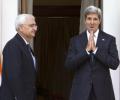
The United States on Monday assured India that its concerns over Taliban insurgents gaining legitimacy without severing their terror links will neither be "overlooked or undermined" during the talks with the Islamic fundamentalist group.

Will voters in Ernakulam take to the Communist MP who asked 447 more questions and took part in 162 more debates than your average MP? Will Arun Jaitley's wish come true? Krishna Prasad, the renowned journalist and Outlook magazine's former editor-in-chief, reports from Kochi.

Rediff.com gives you a look at newbies in the Council of Ministers
The current draft of the Goods and Services Tax could kill any hope of economic revival - and you should blame the Congress if it rolls over and lets it pass, says Mihir S Sharma.
For the first time in our economic history a government has thought about more than 50 per cent of our economic activity instead of the five per cent represented by the Sensex companies, observes IIM-B professor R Vaidyanathan.

President Xi said that the Chinese side is ready to work with the Indian side to carry forward the fresh impetus of bilateral relations.

Andhra Pradesh Chief Minister N Chandrababu Naidu, who was instrumental in developing Hyderabad as a key information technology services destination in the country, is now embarking upon a mission to establish the state as an electronics manufacturing hub.

The American university, once the envy of the world, is in crisis, notes Ajit Balakrishnan in his latest column.

The success story of Adani's Mundra Port in Gujarat, in terms of efficiency, technology and management, should be replicated at Vizhinjam to ensure that this ambitious project does not fail, say Shehzad Poonawalla and Riya Sinha.
Sebi had last year put in place a separate regulatory regime for REITs.

Prime Minister Narendra Modi said India and the United Kingdom are economically made for each other.

Praising the US for turning barriers into bridges of partnership, he said that America had stood with India when the support was needed the most, like when terrorists attacked Mumbai in November 2008 and in other economic endeavours as well

US-based Apollo Global has picked up stake in Indian firms which are not doing that well financially.

Foxconn has said it is aiming to develop 10-12 facilities in India, including factories and data centres, by 2020

Some investors had speculated that the US central bank might put its plans on hold given the jitters overseas.

The UN Security Council has declared the Ebola outbreak in West Africa a threat to peace and security, with UN chief Ban Ki-moon deciding to deploy an "unprecedented" emergency health mission to combat the outbreak that has impacted the lives of millions.

In an online chat with readers overseas consultant NNS Chandra offered advice.

The Republic nominee said, 'I created lot of jobs, built great structures. Sure those are sacrifices.'
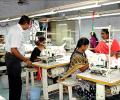
With China and Bangladesh losing their edge, textile exports from Tirupur are rising once again, turning the city into a job magnet.

White House said Trump strongly believed that protecting environment and 'promoting our economy are not mutually exclusive goals'.
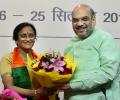
Sudhir Bisht recalls the battle of 1984, in which UP's strongman H N Bahuguna was felled by Bollywood superstar turned political novice Amitabh Bachchan.

'Despite frequent high-level interactions there has been little traction on substantive issues between India and France,' says Mohan Guruswamy.

Here's the full text of President Ram Nath Kovind's customary address to the joining sitting of Parliament on the first day of the budget session.
Coming down heavily on Pakistan, President Pranab Mukherjee has said unless it dismantles the terror infrastructure on its soil, there is no scope for progress in talks between the two countries.

'As the tanks roll down Delhi's Rajpath and the C-17s fly overhead, there could be a lot brewing in Hyderabad House,' says Surya Gangadharan.

'The government is using the Intelligence Bureau to go after NGOs.' 'It is not only the NDA, the UPA also didn't like NGOs.' 'NGOs predominantly work with the poor. So, when you cancel an NGO, the affected are the poor, the Dalits, the tribals, the street children and the marginalised.'
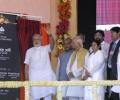
At least 13 attempts were made earlier at modernising.

On November 2, 2010, in his acceptance speech on being elected Governor of New York, Andrew Cuomo declared, 'We got such fantastic help from our brothers and sisters in the labour movement,' and then rattled off half-a-dozen names, including that of labour union activist Neal Kwatra.

In a pre-budget meeting with Finance Minister Arun Jaitley, the experts suggested timely implementation of the BJP's election manifesto promises to fix higher support prices. They also favoured a Kissan TV channel, an efficient procurement policy, priority for farm mechanisation and the linking of rivers.

'The farmer is furious because the MP government is trying to crush their agitation violently.' 'Such actions will have nation-wide repercussions.' 'Why this drama (Shivraj Chouhan's fast) after violently crushing the farmers' agitation?' 'He should resign immediately.'

'India could become the newest Asian tiger under Modi's dynamic leadership. Modi could become the Nehru of the 21st century, and re-establish a new Tryst with Destiny, by stating once and for all that Mera Bharat Mahaan is and will always be a truly secular and inclusive democracy in the best spirit of Bharatiya-tva,' says Ram Kelkar, offering an NRI view of the Modi triumph.
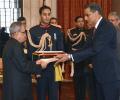
'India is part of our strategic and economic future,' says Richard Rahul Verma, the first Indian American to be appointed US Ambassador to India.

India and China have not ruled out a Modi-Xi meeting during the summit.

Japan Plus to facilitate and fast-track investment proposals.

Here's the full text of Prime Minister Narendra Modi's address to the United States Congress.

'We want to provide data, we want to provide consultation, but we don't want to lecture.' 'The consciousness about this issue in India is starting to get quite high and if we can help contribute to solving this air quality issue in a spirit of partnership with the Indians, it would be a big achievement.'

Aziz Haniffa, who has covered every Indian Prime Minister's visit to the US since Rajiv Gandhi in 1985, gives us a peek into what's happening in Washington, DC on the eve of the Modi-Trump summit.

"I would also like to tell judges that do not be afraid and keep going on the path of justice," Modi said.

'The India-France relationship has been that of the elites of two countries, who appreciate each other's philosophical traditions -- whether it is ancient Indian civilisation and Sanskrit texts or the French tradition of Rene Descartes, Albert Camus, (Jean-Paul) Sartre... This is a drawback. It doesn't create the buzz, the excitement necessary for a relationship. We need more people-to-people contact, especially among students,' says former Ambassador to Paris, Rakesh Sood.
